Continuing in the spirit of the previous article. AI has redistributed workloads within the development process. These have shifted from programming toward prototype verification. Companies are slowly adapting to this, but the process has proven to be much more complex than it initially seemed. This is due to:
- a vast multitude of AI tools competing for market share,
- the narrow specialization of AI tools, which often cover only a small segment of the product development cycle,
- technically and procedurally incompatible AI platforms that complicate the integration of various AI tools into the product workflow,
- the extremely rapid evolution and changes in AI tools, which outpace companies’ ability to integrate them.
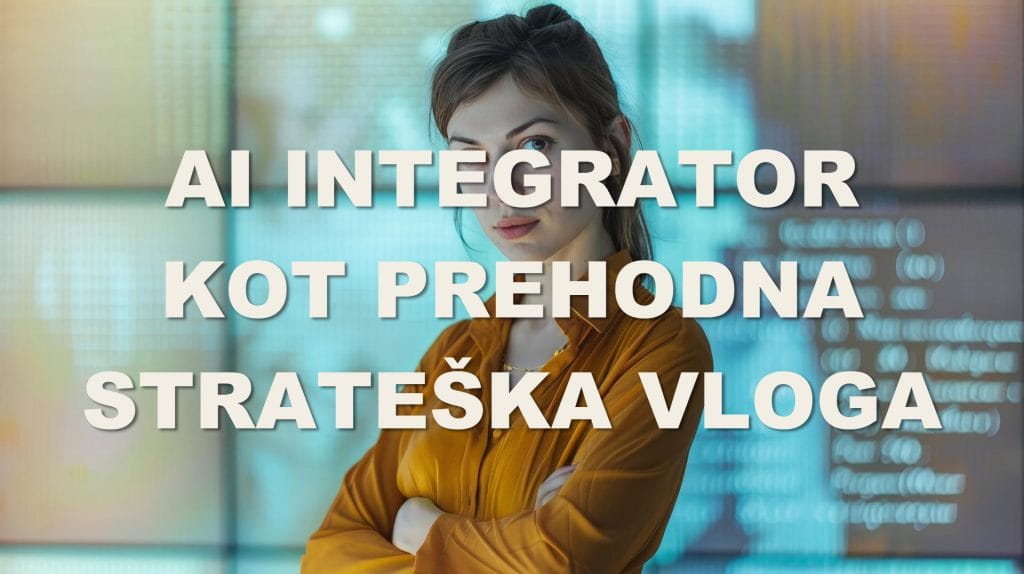
For this reason, a need for the role of AI integrator has emerged within organizations. His/her task is to ensure, during the maturation period of AI tools, that new AI tools are kept up to date and integrated into the development process, while also educating employees.
This, of course, does not mean that from now on, developers will no longer independently research and incorporate AI tools into the process. Not at all. Developers know their needs best. However, the AI integrator will work with developers attempting to integrate these tools into a holistic organizational workflow that also includes product discovery, marketing, and perhaps even finance.
AI integrator will be particularly helpful to the product manager, whose focus must not be on technology, but on user needs.
Tasks of the AI integrator should roughly translate to the following activities:
- Technology scouting – monitoring new models, agents, MCP/API integrations, and specialized AI services.
- Evaluation – practical testing on real organizational use cases, not just monitoring benchmarks.
- Workflow engineering – replacing or adding tools to existing processes and connecting agents, data, and applications.
- Governance – security, privacy, compliance, costs, agent permissions, traceability, and defining boundaries of autonomy.
- Training employees and assisting teams in utilizing new capabilities.
- Continuous optimization – monitoring whether the existing AI workflow still represents the best way of working. Due to the development of new AI tools, it may occasionally be necessary to completely replace the existing workflow with a different one.
The function of the AI integrator is thus somewhere at the intersection of IT architect, business analyst, process engineer, AI expert, and change agent. It can also be viewed as an operational function, but given that the AI integrator’s activity creates a clear competitive advantage, I consider it to be essentially a strategic function operating at an operational level. This function affects the processes of the entire organization.

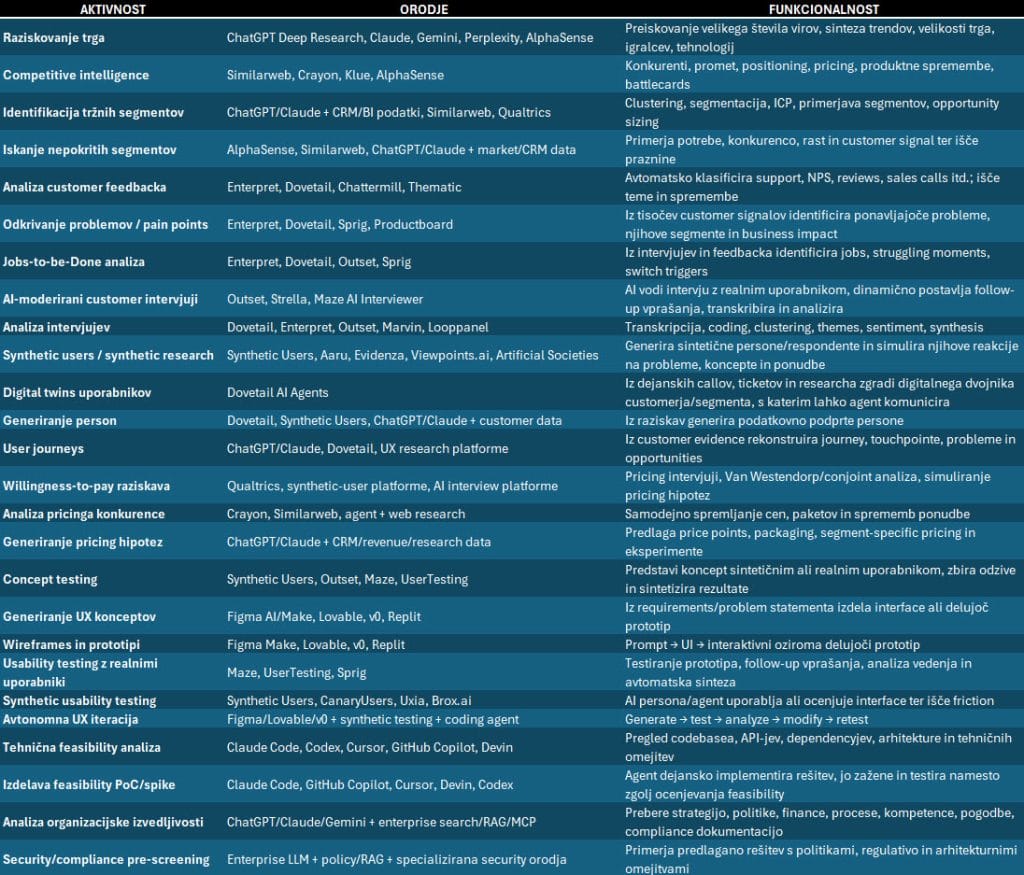
Since the greatest procedural changes are currently occurring in the field of product management, let us return to this activity. At this moment, product management is supported by quite a few (often disconnected) AI tools. The table below is a snapshot of the moment I was writing the article. It was generated by ChatGPT and is not a reference. It is very likely that by the time you read this article, the table will already be slightly outdated. It is here only to illustrate the multitude of tools available to us in the product lifecycle.
Due to their different focuses, the AI integrator must not displace the product manager. The latter primarily deals with non-technical factors and must maintain direct contact with end users. Their focus remains on answering the following questions:
- what do we want to know out about users or the market,
- which Product Discovery methods we will use (interviews, surveys, statistics, user testing, telemetry…),
- which metrics we need for decision-making,
- do users know how to use our solution,
- do we know how to develop the solution,
- does the organization support the development of the solution.
On the other hand, AI integrator will support the development process by answering questions such as:
- which tool we will use to measure the impact,
- which agents, models, or APIs will be most useful in this regard,
- how to connect AI tools into an efficient organizational workflow,
- which data sources we need,
- what limitations we set for AI agents,
- local vs. SaaS models/vector databases,
- build vs. buy – preventing vendor lock-in
These activities can be envisioned as an abstraction layer that operationally supports the realization of product management needs and other organizational functions. These functions use AI services regardless of which underlying technology currently supports those services.
CONCLUSION
The AI integrator is a transitional role that will provide organizations with a cutting-edge competitive advantage during the turbulent development of AI tools. Once AI tools mature and market consolidation occurs, this role will likely become redundant, and its tasks will be dispersed throughout the organization. The AI integrator will likely follow the path of build engineers, classic DBAs, and tape operators. The technologies still exist, but they have been operationally absorbed by other processes and integrations. At this moment, however, it is a strategically important role.