
Consulting
The decision to undergo an Agile transformation is not just a change in methodology. It’s a strategic decision with far-reaching consequences that requires honest self-reflection: is the organization ready to create an environment where multidisciplinary Agile teams can realize their creative and execution potential?
When consulting with organizations, I first assess whether an Agile approach is appropriate for their environment. Agility is not a universal solution, and in certain circumstances, traditional approaches remain the better choice.
The assessment typically considers the following factors:
- The degree of uncertainty in product development
- The possibility of incremental delivery of business value
- The organization’s readiness for change
- The level of customer collaboration with development teams
- The suitability of the existing organizational structure.
Based on the findings, I prepare a recommendation for next steps.
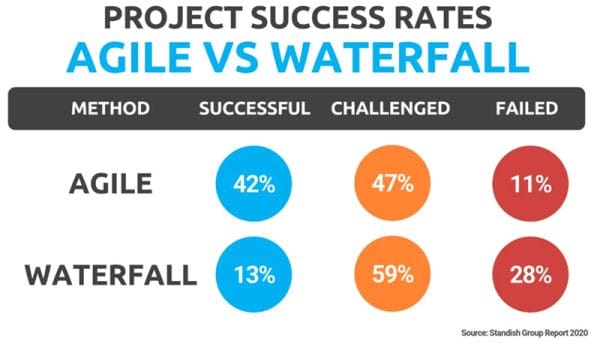
Market results confirm the effectiveness of Agile approaches in the development of technology products. They are used by both disruptive start-ups and multinationals from all segments of the economy. They cover both software development (Google, SAP, Atlassian, Amazon…) and hardware development (NVIDIA, Bosch, Sony…). Agile approaches are also used in highly regulated industries such as pharmaceuticals (Roche, Novartis, Pfizer, Bayer…), medical devices (Siemens, Philips…) and defence (Thales, SAAB, BAE Systems…). A number of currently large software companies made their breakthrough as a startup through the Agile product discovery process (Slack, Figma, Spotify, Uber, GitHub…).
In general, the decision to adopt an Agile approach is conditioned by the following factors:
- We’re developing a solution where the goal is known, but the methods to achieve it are not. Or:
- We are developing a solution where the goal is loosely defined and may change during the project based on new insights that emerge during development.
- The proposed solution is in a form that allows incremental realization of business value.
- The contractual relationship allows for an incremental implementation of the solution.
- The development organization allows and supports the use of Agile approaches.
- The Customer is willing to participate in the development process on an ongoing basis.
The above conditions are a solid basis for a successful transition to Agile working. There are several approaches to the implementation itself. The most common initial step is to set up an isolated Agile “incubator” – a unit that supports one or two development teams within a Scrum, Kanban, XP or Lean Startup framework.
Successfully executed pilot projects typically lead to the formation of new Agile teams that join existing ones. Such organic evolution gradually covers the entire organization with minimal disruption over time. This transformation naturally leads to the need for Scaled Agile approaches (Scrum@Scale, LeSS, Nexus). These enable coordinated work of multiple development teams on the same product. They differ in how they intervene in the existing company structure.
Why Agile?
Compared to the classic waterfall approach, Agile development enables:
- Shorter “Time to Market” and greater responsiveness to market pressures.
- Lower development costs due to early validation and adaptability.
- Faster return on investment.
- Increased customer satisfaction and loyalty by developing solutions that adapt to their real needs.
- Increased market penetration and competitive advantage by fully harnessing the innovative potential of development teams.
- Higher employee motivation and retention, resulting in better utilization of resources invested in their education.
A key success factor for Agile Development is the constant presence and involvement of the client. In a Scrum environment, this role is played by the Product Owner, but it has analogous functions in other frameworks.
In practice, the role of the Product Owner is much more than just the voice of the customer. It is a holistic product management role that links marketing strategy, customer experience and development. Unfortunately, this role is often poorly understood and, as a consequence, less well supported organisationally, despite its direct impact on the business success of an initiative.
Would you like to find out whether your organization is ready for Agile transformation and how to implement it thoughtfully?
Contact me. I will be happy to start the conversation.

How is consulting done
I provide consulting on Agile Transformation as part of the Scaled Agile course, where the client gets one hour of free consulting for each student.
Consultancy usually consists of the following packages, which may vary depending on the specificities of the organisation:
- Assessment of company readiness for implementing Agile and/or Lean approaches
- Selection of appropriate Agile framework based on organizational structure, culture, and market factors
- Support in the market opportunity discovery process (product discovery)
- Advice on internal reorganisation to support Agile teams (gradual evolution, not revolution)
- Professional guidance in implementing Agile practices, until the company becomes independent and mature enough for further growth without external help (including mine)
- If needed, connecting with specialists for specific development areas
A more extensive consultation on Agile Transformation is available as a stand-alone service. For more information, please contact me at sales@deltaagile.com.

Free Consulting as Part of Research Work
I offer selected organizations long-term complimentary consulting in exchange for participation in a research project developing a proprietary hybrid Agile/Lean methodology.
This collaboration model includes:
- Initial introductory consulting block
- Regular strategic meetings (monthly or 10x yearly) where we monitor transformation progress and together remove obstacles
- Direct support and guidance during key transformation phases
This gives your company a long-term opportunity to get free advice and guidance in the complex process of Agile transformation, and I get statistical and practical information for my professional work. Startups and companies with interesting product portfolios are preferred for this type of consultancy.
If you are interested in collaboration, whether through a course, individual consulting, or research partnership, write to sales@deltaagile.com.
Let’s discuss the options that best support your organisation on the path to Business Agility.