
In this article, I summarize the findings of an extensive (142-page) study titled DORA State of AI-assisted Software Development Report. It was conducted on a sample of more than 5,000 developers. Due to the novelty of the subject, this year’s is only the second edition.
Compared to last year, the research revealed several positive and some negative consequences of introducing AI into software development environments. The most important result of the research is the identification of seven good practices that enable effective integration of AI into the organizational development ecosystem.
Let’s look at the most important findings, and then the seven factors mentioned.

Key findings
2025
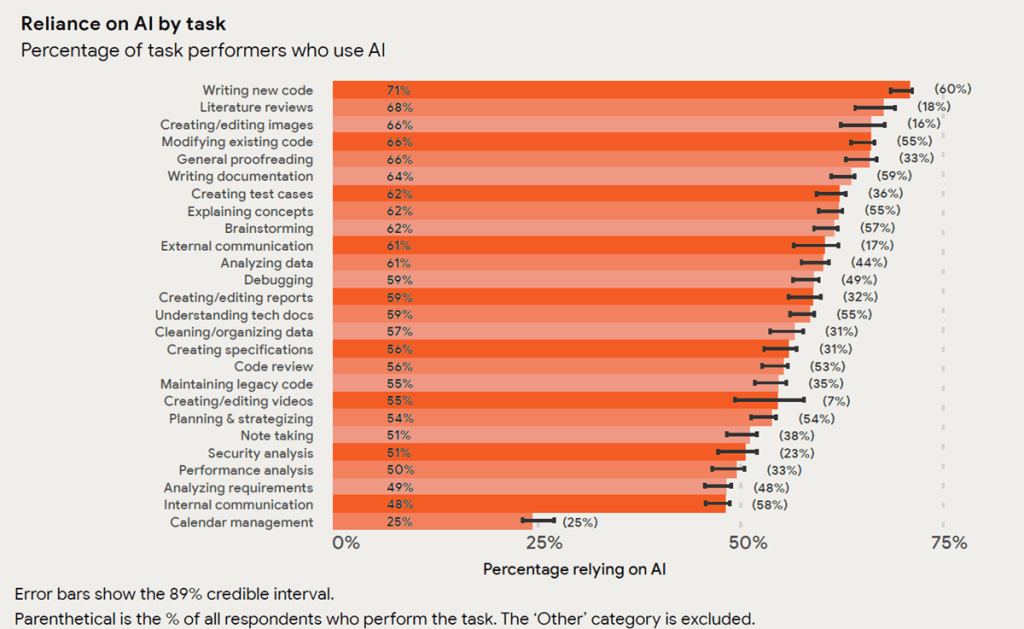
- 90% of surveyed developers use AI in their work
- Of these, 80% believe they have increased their productivity with AI
- 30% of developers don’t fully trust AI-generated code
- Incorporating Value Stream Mapping practices exponentially increases the positive effects of integrating AI into the software development process
- AI increases the throughput of developed functionalities through the development process
- The use of AI still has a negative impact on release stability
- 90% of organizations use standardized development platforms. A quality platform is one of the conditions for effective AI integration.
- Successful AI integration is an organizational, not a technological issue


Compared to 2024
- The perception that AI allows developers to work on important things has shifted from negative to positive.
- The amount of functionality flow through the development process under AI influence has shifted from a decrease to an increase.
- The perception of AI’s impact on the efficiency of developed solutions has shifted from negative to neutral.
Other conclusions
AI in software development acts as a multiplier. This means it adds value to highly efficient organizations and reveals dysfunctions in those with systemic problems. The primary advantage of AI investments does not come from the tools themselves, but from the strategic focus on the fundamental organizational system.
This includes, among others:
- Quality of internal platforms
- Transparent workflows
- Alignment of development teams
Without these basics, AI often creates silos of higher productivity that, due to process bottlenecks, do not contribute to the overall result.
Seven factors for effective AI implementation in an organization
1. Clear and communicated stance on AI
The organization must provide employees with an understandable and informed official position on how developers should use, or are allowed to use, AI-supported software development tools.
According to surveys, this position should contain 4 items:
- To what extent developers are expected to use AI in their work.
- To what extent the organization supports developers’ experimentation with different AI tools and approaches.
- Which AI tools are allowed.
- To what extent the organizational AI policy directly relates to specific employees.
An organization with a clear and communicated stance on AI is therefore one that encourages and expects AI use from its developers, supports their experimentation with AI, clearly defines which tools are allowed, and how the AI policy applies to employees.

2. Healthy data ecosystems
This item addresses the general quality of internal data systems in the organization. According to the research, the health of data ecosystems as a factor consists of three individual indicators that measure respondents’ perceptions of:
- the general quality of internal data sources;
- the accessibility of internal data sources;
- the mutual isolation of internal data sources (silos).
An organization with a healthy data ecosystem can therefore be understood as an environment where internal data is of high quality, easily accessible, and interconnected.
The research concludes with a high degree of certainty that the positive effects of AI implementation depend on whether organizations have healthy data ecosystems.
We often hear that artificial intelligence models are only as good as the data they learn from. In this case, it appears that this generally accepted wisdom also applies at the local, organizational level.
When organizations invest in establishing and maintaining quality, accessible, and connected data ecosystems, they further enhance the success of AI tool implementation.
3. Internal data accessible to artificial intelligence
A factor that logically follows from the previous one. It refers to the degree to which AI tools are connected to internal data sources and organizational systems. The accessibility of internal data is measured as a factor composed of four individual indicators that measure respondents’ perceptions of:
- the extent to which AI tools they use at work have access to the company’s internal information;
- the extent to which AI tool responses are based on the context of the organization’s internal information;
- the frequency of inputting internal organizational information into AI queries;
- the frequency of using AI tools to obtain internal organizational information.
An organization with an internal database accessible to AI can therefore be understood as one where employees notice that internal data is available to their AI systems, and these tools also use it.
The research concludes with a high degree of certainty that with the above conditions met:
- individual efficiency increases
- code quality improves
Although AI tools trained on general datasets (ChatGPT) help developers feel more efficient and create higher quality code, this finding suggests that the positive impact is further enhanced when AI has access to internal data sources for contextual solutions.
Maximizing the benefits of AI in terms of individual efficiency and code quality thus requires a greater investment than just acquiring AI licenses.


4. Quality version control
In the era of generative AI, when the quantity and speed of code generation are dramatically increasing, the importance of this practice is further enhanced. The research shows a strong synergy between the maturity of version control use and AI usage. This proves that these practices are key to maximizing the benefits of AI while simultaneously reducing its risks.
The research concludes with a high degree of certainty that the positive effects of AI implementation depend on the frequency with which developers commit to the version control system. With frequent commits, the positive impact of AI on individual efficiency is strengthened.
The same applies to “rollback”. With more frequent reversions, the positive impact of AI on team performance increases.
A key aspect of version control is its function as a “psychological safety net”. This safety net allows development teams to experiment and innovate with greater confidence, knowing they can easily return to a stable state at any time.
5. Working in small batches
This is the degree to which teams break down functionalities into manageable units that can be quickly assessed for complexity and tested. Working in small batches is measured as a factor composed of three individual indicators that measure:
- the average number of lines of code committed in the last trunk version;
- the number of changes typically merged into a single release;
- the time it takes a developer to complete one task.
A team achieving higher efficiency is one that executes fewer lines of code per commit, fewer changes per release, and breaks work into smaller pieces.
The research concludes with a high degree of certainty that the positive effects of AI implementation depend on whether teams practice working in small batches. The consequences of such practices are:
- increased impact of AI on product success;
- reduced friction within the team and among stakeholders.
On the other hand, the research finds that the benefits of AI implementation in terms of individual efficiency are somewhat reduced for teams working in small batches.
Working in small batches increases reported product success while reducing perceived friction in teams using AI. The authors believe these benefits outweigh the potential lower individual efficiency when working in small batches. After all, individual efficiency is not the key factor in team effectiveness.

6. User focus
This refers to the degree to which teams think about the end-user experience of their application or service.
There’s not much to add here, as this mantra has been proven even from times before the emergence of AI in development processes.
The research concludes with a high degree of certainty that the ROI of AI implementation depends on the level of team focus on end users. Specifically, when AI is used by teams with a strong user focus, its positive impact on reported team performance increases.
However, it’s also important to note that if a team is not focused on end users, the introduction of AI has a negative impact on team performance, as it only amplifies existing dysfunctions.
These findings suggest that organizations promoting AI adoption will benefit most if they incorporate a deep understanding of end users, their goals, and feedback into their product plans and strategies. At the same time, they present an important warning: without user focus, AI implementation can harm team performance.
7. Quality internal platforms
The term “platforms” refers to a set of capabilities that are common to multiple applications or services and are widely accessible (and used) within the organization.
The research concludes with a high degree of certainty that in organizations with quality internal platforms, the positive impact of AI on organizational performance increases.
On the other hand, respondents report more friction in organizations with quality internal platforms. What could be the reason for this?
Quality internal platforms increase individual efficiency by providing development teams with a unified set of capabilities on which they can easily build. However, the standards set by these platforms also set boundaries regarding the use of development tools – for example, by defining internal APIs that have stricter security controls than external ones.
In this way, internal platforms fulfill their function by increasing access to desired functionalities on one hand, while limiting access to undesired ones on the other. This could explain the increased friction among more intensive AI users, which is not necessarily a negative consequence for the organization.

Conclusion
AI is here to stay. Developers are not competing with AI for their jobs, but with professionals in the same field who are using it. Organizations, on the other hand, compete with others that are implementing AI in a more proper way and on healthier foundations.